
Selling through ChatGPT is a new e-commerce channel where the customer goes from inquiry to product recommendation and purchase with minimal "friction" (fewer clicks, fewer abandonments). Conclusion: if you have a structured catalog, good product data and embraced payments/returns, you can prepare your store now and enter the channel earlier than your competitors.
What's already possible with ChatGPT today
ChatGPT not only answers questions, but can show specific products, compare them and enable real-time purchasing. For the user, it looks natural: he enters a question, such as "the best gift for a runner up to £300," gets recommendations and can click "Buy now" without leaving the chat room.
This solution is called Instant Checkout. They are supported by Agentic Commerce Protocol (ACP), an open standard that connects ChatGPT to the online store and payment system. In practice, Instant Checkout + ACP means that a customer can select a product and pay without leaving the chat, and the store automatically receives the order and fulfillment data.
Simply put: ChatGPT becomes the intermediary between the customer and your store, and ACP makes sure that the transaction goes safely and according to your rules.
At this point, sales through ChatGPT mainly work for stores based on Shopify and Etsy. These platforms have been integrated "automatically," meaning that if your store runs on one of these systems, you are already one step closer to entering this channel. Other stores can implement the integration through ACP, an open standard provided by OpenAI.
NOTE: full checkout via ChatGPT is currently being developed first in the US market - in Poland, integration with Shopify/Etsy is in the discovery stage (you can see the products, but purchase from chat is not yet fully available).
It is worth emphasizing that ChatGPT does not replace your store. It's a new entry channel designed to lead to more conversions with less friction on the user side.
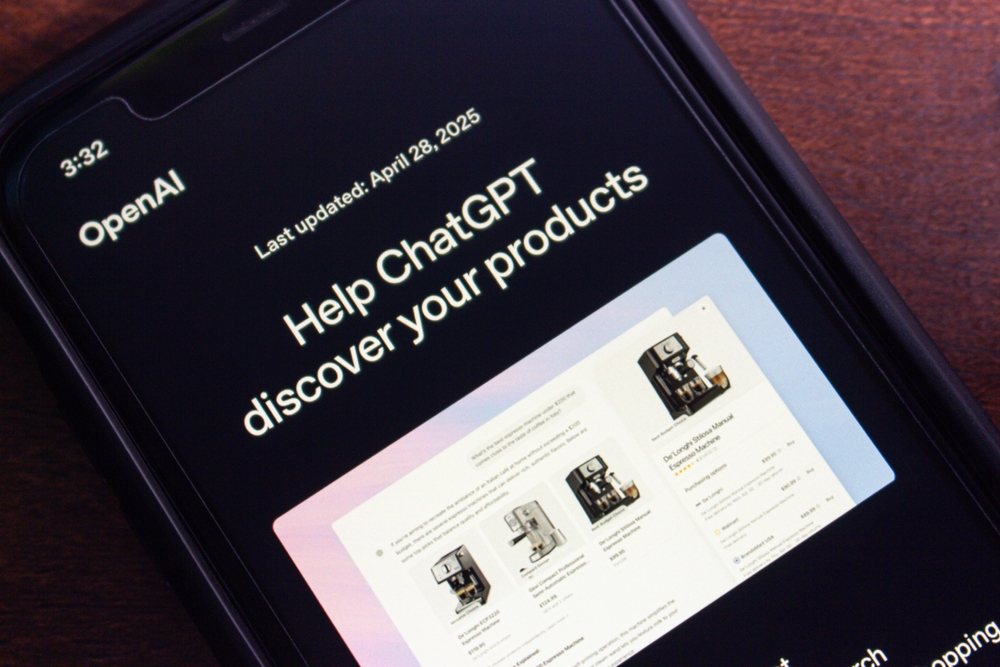
E-commerce and ChatGPT - how the path from conversation to purchase works
Imagine that a user writes:
"I need a cream for sensitive skin with UV protection, preferably from a Polish manufacturer."
ChatGPT analyzes the query, searches the partner database (i.e. integrated stores) and presents several products with description, photo and price. If your store has an active ACP connection, a button will appear Buy.
- The user selects a product - Clicking "Buy" initiates a connection between ChatGPT and your store.
- ACP submits data - The system sends order details to your back office, confirms availability and price.
- Payment - ChatGPT uses integrated payment processors such as. Stripe or PayPal, which handle payment in chat and transfer funds directly to your system.
- Confirmation - The customer receives a message about a successful purchase, and you process the order as usual: pack, ship, invoice.
From the user's point of view, it's an instant process. From the store's point of view, it's fully secure and compliant, as ACP requires event logging, payment confirmations and RCP (Regulated Commerce Protocol) compliance. RCP is a security layer that takes care of regulatory and data protection compliance of transactions.
If you want to learn about the technical aspects of this integration, the full "agent → store → payment" architecture and a sample implementation roadmap, take a look at our article: Agentic Commerce Protocol (ACP): how to prepare your store for ChatGPT shopping..
Where are ChatGPT sales already taking off and what results are they producing?
At the moment, full implementations of sales by ChatGPT can be found mainly in the United States. Shopify announced that more than one million vendors will be able to use the feature without additional action on their side. Etsy has launched a pilot that allows ChatGPT users to buy handicrafts and niche products without leaving the chat room.
PayPal and Stripe have announced a partnership with OpenAI to handle payments in the model Instant Checkout. As a result, users do not have to enter their card details in the chat - payment is made in an encrypted manner and in accordance with local regulations.
This model is changing the balance of power in e-commerce. Stores that build good visibility in ChatGPT (through the correct feed, structured data and integration) can acquire customers at the conversation stage before they hit the classic search engines.
For more on how discovery works in ChatGPT, how to submit a store to the ChatGPT Merchants program and how to prepare a feed, see our article: Store visibility in ChatGPT: how product discovery works and how to appear there.

How to evaluate whether selling through ChatGPT makes sense for your store
Not every e-commerce business will benefit immediately. To assess whether it's a channel worth investing in, it's worth going through a short checklist.
1. average order value (AOV)
Chat sales work best with products of simple choice and unit value that do not require a lengthy decision-making process.
2. margin
Check to see if the margin allows you the additional cost of the channel or potential integration fees.
3. catalog and product data
ChatGPT uses structured data. If your products have accurate descriptions, photos, and current availability, you'll have an advantage. Descriptions, photos, current availability, Product variants (sizes, colors) and high-quality images are very important for high visibility in ChatGPT.
4. payment system
If you are using PayPal or Stripe, you are ready for initial testing. Other gateways may require intermediate integrations.
5. handling orders and returns
The returns process must be clear and automated. A chat shopper expects simplicity and quick refunds.
6 Markets and currencies
Sales through ChatGPT are developing first in English-speaking markets, but PLN feeds and stores running on Shopify are already technically compatible.
7. organizational readiness
Is your marketing and IT team capable of conducting the pilot? Do you have someone to handle data analysis and post-test corrections?
If most of the answers are "yes," it is worthwhile to start the preparatory stage.
Limitations and risks to keep in mind
- Effectiveness depends on the quality of the product feed (descriptions, images, availability, variants).
- Dependent on changes on the platform side (OpenAI, Shopify, Etsy) - integrations may evolve.
- Implementation requires testing - recommended gradual introduction of products, monitoring of errors and user behavior.
- Not all payment methods and markets are supported in every country.
The Polish perspective: today and tomorrow
Although the full functionality of Instant Checkout is not yet available in Poland, there is nothing to stop you from getting ready. ChatGPT Search is already operational in our region, and integrations with Bing Merchant Center are officially supported.
What can be done right now:
- Arrange product catalog and metadata.
- Standardize the product feed (PLN, shipping, availability, return policy).
- Check if your store is visible in Bing Merchant Center.
- If you are using Shopify, verify your configuration for the following ChatGPT Shopping.
Despite the lack of a full checkout in Poland, stores that prepare feeds and structured data now will have an advantage when shopping is launched.
How to prepare step by step
- Do an AI-ready audit - check if your store has complete structural data, correct feed and well-described products. For more details on how you can do this, see our article: Is your store AI-ready? ChatGPT's sales readiness audit
- Take care of the technical basics - Integration with PayPal or Stripe, full compliance with RODO, event logs, email confirmations.
- Prepare landing about shopping through AI - Show users that you are ready for a new channel, and collect leads.
- Plan a pilot test - Choose a few products and build a mini shopping scenario.
- Monitor the data - Analyze the number of clicks, conversions, user questions.
How to improve product visibility in ChatGPT
- Ensure the completeness of the feed (title, description, price, availability, variants, photos).
- Use structured data (schema.org / product + offer).
- Keep product names consistent - ChatGPT recognizes categories better when products are uniquely named.
- Take care of return policy, shipping and currency - these fields are also taken into account in the rankings.
- Test queries - observe what phrases users type and adjust the naming.
Shopping at ChatGPT - why start now?
History shows that the first to adapt new shopping technologies often gain an advantage that is difficult to catch up with. That was the case with Google ads, then with Facebook campaigns, and now comes the moment of shopping via ChatGPT.
Selling through ChatGPT won't replace your store or SEO, but it can open up a new traffic channel that reaches customers earlier than your competitors. And how well you prepare now will determine whether you are among the pioneers or only among the followers.
Summary - e-commerce in AI language models
Selling through ChatGPT is not a fad, but an evolution of e-commerce towards conversation and instant purchase. Today, you can gain an advantage by preparing data, feeds and processes. When the channel becomes widespread, your competitors will just start learning, and you will already have the infrastructure ready.
FAQ - frequently asked questions
Does selling through ChatGPT require major technical changes?
Not always. If you are running on Shopify or Etsy, many integrations happen automatically. In other cases, you will need ACP configuration - described in [LINK → article 2].
Does ChatGPT charge a commission on sales?
As of now, there is no official price list. Vendors handle payment through their own providers, so costs depend on your payment gateway.
Can users in Poland already buy in chat?
Not to the full extent. The Instant Checkout function is being introduced in stages, but product discovery at ChatGPT is also working for Polish users.
What products sell best via chat?
Impulse categories are doing best at the start: accessories, cosmetics, consumer electronics, everyday products.
Is shopping through ChatGPT safe?
Yes. Payments are handled by certified operators (e.g. PayPal and Stripe), and transaction data is not stored by ChatGPT. ACP and RCP require event logging and compliance with data protection regulations.
How do I submit a store to the ChatGPT Merchants program?
Submissions are made through the Shopify / Etsy panel (if applicable) or through the ACP integration form. An active product feed, return policy and compliance with payment methods are required.